Your puppy grabs your heel mid-stride and you react, you shout, you spin around, you push them away. The nipping stops for about four seconds. Then it starts again, harder. If this is your life right now, you probably own a Kelpie, a Blue Heeler, a Border Collie, or something with a bit of all three in it.
Heel nipping isn't aggression. It isn't bad manners. It's 5,000 years of selective breeding doing exactly what it was designed to do. Luke Buchanan, Owner of The Toe Beans Co and Sydney's Puppy Trainer, works with herding breeds regularly, they make up a significant portion of puppies in Sydney, particularly across the inner suburbs and Eastern Suburbs. Here's what's actually happening, and what stops it.
Why some puppies nip at heels and others don't
The difference is genetic. Herding breeds. Kelpies, Blue Heelers, Border Collies, and their crosses, were selected over thousands of years for a specific behaviour cluster: close-quarter movement tracking, pressure application to direct livestock, and high sensitivity to fast lateral movement. Heel nipping is part of that cluster.
What triggers it specifically is the movement of feet and lower legs. Fast walking, sudden direction changes, children running, shuffling on the spot, all of these activate the same neural pathway that would, in a working context, tell the dog there is something that needs to be moved and it is the one to move it.
The mechanism is visual. The lower leg and foot at that height sits exactly in the dog's field of active attention during movement. Motion triggers pursuit. Pursuit triggers the nip. There is no malice in that sequence. No defiance. It is a stimulus-response pattern with a genetic fuse.
Not all puppies within these breeds show it at the same intensity. A Kelpie from strong working lines will show it earlier and more forcefully than a Kelpie from generations of pet breeding. A Labrador, which was selected for completely different traits, doesn't carry this trigger at all. Owners who've had Labs before are often genuinely shocked when their first Kelpie behaves this way at nine weeks. It isn't because they're doing anything differently. The breed is doing what the breed was built to do.
What I see with every Kelpie puppy that comes through is that owners have already tried scolding by the time they get to me. The nipping has often got worse, not better. There's a specific reason for that, which I'll come back to.
This is important to establish before anything else: the owner didn't create this problem. The breed arrived with it pre-loaded.
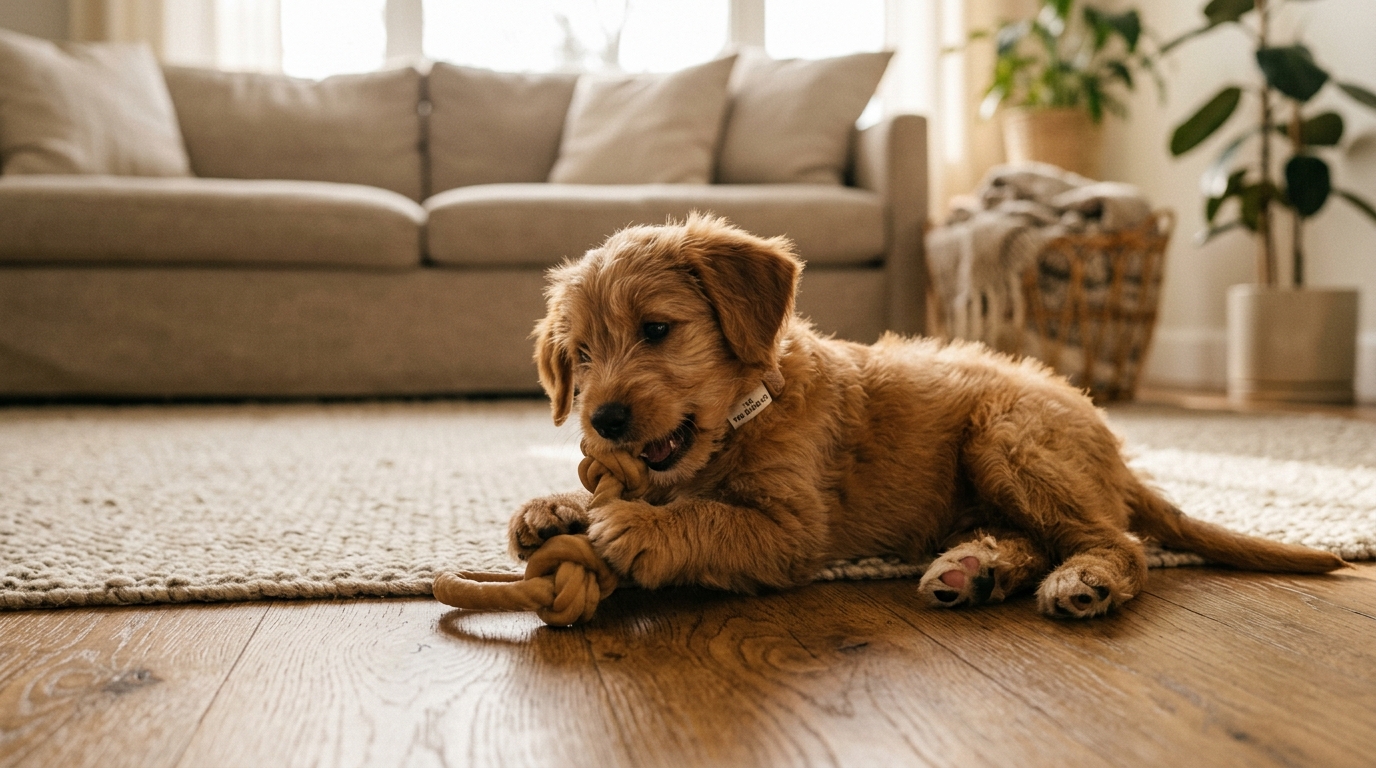
The herding instinct explained
What the dog is actually doing has specific names in herding work. Flanking is moving around the outside of a group to contain it. Drafting is using body position to push animals forward. The nip is pressure application, a precise physical cue used to move a recalcitrant animal that hasn't responded to proximity alone.
In sheep work, this is a skill worth a great deal. The most effective working dogs passed it on. The less effective ones didn't. That process has been running for approximately 5,000 years. The Border Collie in particular has one of the most intensely selected genetic profiles of any domesticated dog breed.
So when a Border Collie puppy fixes its gaze on your moving feet and launches, it's not attacking. It's working. The target just happens to be your ankles rather than a mob of Merinos. The absence of livestock doesn't switch the instinct off, it just means the instinct finds whatever movement is available.
Aggression in dogs involves threat signals: a stiff body, direct eye contact, growling, a deliberate threat display before contact. None of that is present in heel nipping. The dog's body is typically loose, the movement is reactive rather than predatory, and there's no escalating threat sequence. You are watching a dog doing its job. It just has no sheep.
The Blue Heeler was specifically developed in Australia to work cattle on long drives, which required a dog that could work close, take pressure from hooves, and apply quick, precise nips at the heels of cattle to keep them moving. The Blue Heeler breed guide covers this in more detail. The Kelpie guide does the same for Australia's other iconic working breed.
When it's just play, and when it's overstimulation
These look similar but they're different in cause, in feel, and in what they need.
Play nipping has a looseness to it. The whole dog is bouncy: soft eyes, a relaxed jaw, interrupted movement where the dog pulls off, resets, and comes back. The bite pressure is light. The dog disengages easily when you stop moving or change the dynamic. There's often a play-bow in the mix.
Overstimulation nipping feels different. The dog's gaze becomes fixed on the feet or legs specifically, less aware of the wider environment. The grab is harder. There may be gripping, shaking, or tracking rather than disengaging. Redirection is harder, the dog is less responsive to its name, a verbal cue, or a change in your body position.
Walking pace is the main dial for herding breeds. A slow walk rarely triggers it at the same intensity a fast one does. Quick direction changes, running, shuffling, all raise arousal rapidly because those movement patterns mimic evasive livestock. Children are the highest-risk combination: they run, they change direction suddenly, they make noise.
Why scolding makes the herding instinct worse
When a dog in a herding-activated state sees movement and applies a nip, and the owner responds by shouting, waving their arms, turning suddenly, or moving quickly away, every single one of those responses is an input the dog's herding drive reads as confirmation that something needs to be chased and controlled. More movement means more to herd. More noise means more arousal. The owner has just fed the loop.
The yelp method gets recommended everywhere, and it works reasonably well in play-biting Labradors and Golden Retrievers, who read it as social feedback: they hurt you, they back off. I don't get the same result with Kelpies and Blue Heelers. The nip isn't part of a play sequence for them, it's a working behaviour, and a yelp doesn't interrupt a working dog the way it interrupts a playing one. What actually works is removing the thing the instinct is responding to, your movement.
The correct intervention is not after the nip has landed. It's at the first signs of pre-nipping arousal, the fixed gaze, the lowered body, the shift in focus to your feet, before threshold is crossed. Once it's crossed, your options shrink dramatically.
Two tools do the work here. If your puppy is already keyed up and walking fast, fixated on your feet, run a few rounds of stop-start-change-direction: stop without warning, start again, change direction, always turning in front of your puppy so it's tracking you rather than the other way round. Do it in silence, talking reduces how well it works. It brings the arousal down before the nip happens. If a nip has already landed, or your puppy is already at your ankles, use the calm freeze. Take a calm, underhand grip under the collar, palm up, under the chin. Say nothing. Hold until your puppy settles, then release.
Giving the instinct a job
The goal with herding breeds is never to eliminate the drive. You can't. It's built into the genome. The goal is to give it a legal outlet so the overflow doesn't find one on your ankles.
Trying to tire a Kelpie out so it stops nipping is one of the most common mistakes I see. Owners who go down that road find they've raised the dog's cardiovascular fitness and its arousal set-point simultaneously. The dog can now sustain the behaviour longer. Physical exhaustion and genuine neural calm are not the same thing.
What works is teaching self-regulation, the dog learning that the highest-value outcome comes from a calm, controlled state rather than an activated one. This is where positive reinforcement and the Relational Leadership framework meet.
Structured games that use controlled movement and direction changes give the drive somewhere legitimate to go, the same close-quarter tracking and pressure-application pattern the breed was bred for, just aimed at a ball or a lead instead of your ankles. Herding-specific activities like Treibball are worth looking into once your puppy's a bit older, if you want a formal outlet for it. The Complete Puppy Program builds impulse control and drive management in from the earliest weeks, because herding breeds need this work started early, not added on once the nipping is already a habit.
The redirect ladder that actually stops it
This is the same age-graded approach TBC uses for any puppy mouthing, adjusted for the fact your legs are the trigger here, not your hands.
At eight to ten weeks, don't correct at all. Carry a toy on walks and redirect the mouth to that the moment the nip starts. No drama, no reaction, just swap the target.
From twelve to fifteen weeks, if the redirect on its own isn't landing, add the calm freeze described above: underhand grip under the collar, palm up, under the chin, say nothing, hold until your puppy settles, release, then offer the toy again.
If your puppy is already worked up before you get there, run stop-start-change-direction first to bring the arousal down before you try the freeze.
From sixteen weeks, if the nipping is still landing after the redirect and the freeze, that's a timeout. Calmly end the interaction, no lecture, just remove the opportunity.
If your puppy is in a genuinely wild state, skip the freeze and go straight to the timeout. Holding a dog through a full-blown overstimulation spiral rarely works.
Consistency across the household matters more than any single technique. Everyone uses the same sequence, or your puppy is getting mixed signals about what stops the game.
When to bring in help
Most heel nipping in herding breeds responds to consistent application of the redirect ladder within one to two weeks. But there are specific circumstances where professional support is needed rather than optional.
If the nipping is breaking skin, the bite pressure is beyond what threshold management alone can address in the short term. Get a trainer involved before the behaviour compounds further.
If the behaviour is directed at children specifically. Herding behaviour toward small children carries a different risk profile, children move unpredictably, can't apply the calm freeze or the redirect themselves, and can't read pre-nipping signals. If a herding-breed puppy is targeting children consistently, don't wait.
And if the frequency isn't reducing after two weeks of correct, consistent technique, there's likely something else contributing. That's not a failure of the owner. It's a signal that the picture is more complex than a blog post can address.
Want help putting this into practice?
The Toe Beans Co runs a free SKOOL community where Sydney dog owners get access to training guides, Q&As, and direct support from Luke. It's free to join.
Frequently asked questions
My puppy only nips the kids. Why?
Children are a perfect storm of herding triggers, they run, change direction suddenly, make high-pitched sounds, and are at the exact height where the dog's herding focus lands. It's not that your puppy dislikes the children. It's that every element of how children move activates the herding instinct more intensely than adult movement does. The approach is the same (redirect, then the freeze if needed, reward calm), but adult supervision during any off-lead interaction is non-negotiable until the behaviour is well under control.
Is this related to puppy biting?
They look similar but the mechanism is different. General puppy biting is play and exploration behaviour driven by teething, social learning, and over-arousal. Heel nipping in herding breeds is instinct-driven and specifically triggered by movement. The key difference is specificity, herding nipping targets moving legs and feet and is triggered by pace changes. The approaches overlap, the same redirect-then-freeze sequence TBC uses for general mouthing applies here, but herding nipping responds better to removing your movement (the freeze, or stop-start-change-direction if you're mid-walk) than to a yelp.
Do I need to give my puppy a herding job?
Not a literal one. But herding breeds do need outlets for the drive, and the quality of those outlets matters more than the quantity. A Kelpie that's been on two long runs still needs its brain engaged, physical exhaustion doesn't silence the herding instinct. Treibball, nose work, structured obedience with movement, and recall games that incorporate direction changes all give the instinct something legitimate to engage with. The goal isn't to exhaust the breed. It's to build the self-regulation that lets them choose calm over activation.