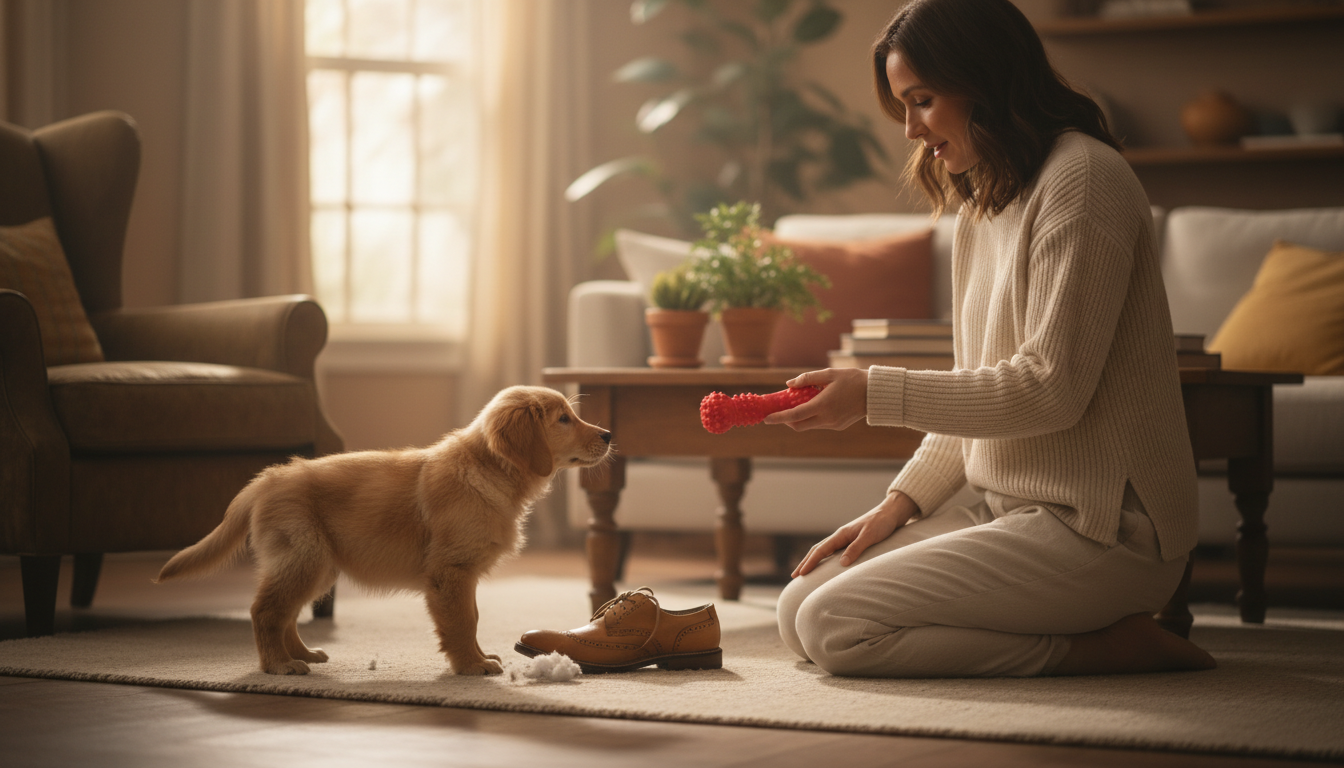
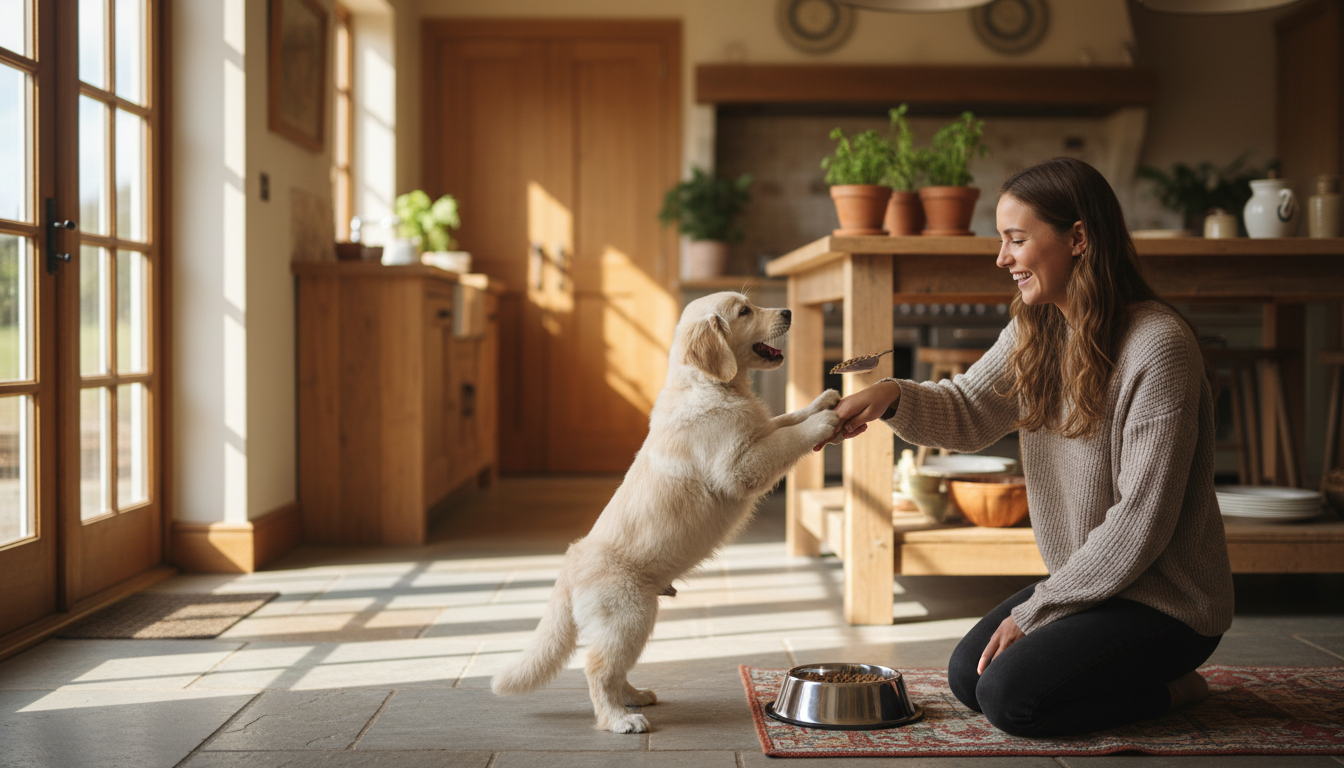
Your puppy is barking for one of five reasons. Knowing which one is the difference between fixing it and reinforcing it. Most owners apply the same fix to every type of bark and accidentally make the worst type worse. This piece is the puppy-specific version of bark diagnosis, anchored to the eight to sixteen week window when the patterns are being set.
If you have an adult dog and you need the general version, the existing pieces on excessive dog barking and apartment door barking cover that ground. This piece is for the puppy.
The five reasons puppies bark
Demand barking
Sharp, repetitive, high-pitched barks directed at you rather than at the environment. Your puppy makes eye contact. It happens at the food bowl, at the lead before a walk, at a toy they want thrown, at the crate door when you are nearby. The giveaway is the directional quality. This bark is aimed at a specific person to produce a specific outcome. Pitch often rises if ignored. It stops the instant you respond, even negatively.
This bark exists because at some point it worked. A glance, a word, the bowl moving an inch closer. That was enough. Your puppy's nervous system registered: that sound changes things. At eight to sixteen weeks, puppies are forming their understanding of how to influence the world. Demand barking is efficient. It is learned, not defiant.
Alert barking
Sharp, sustained barks directed toward the boundary of your puppy's space. A window, a fence line, the front door. Body weight is forward. Ears pricked. Gaze locked on the trigger. In a Paddington apartment, this is the footsteps in the corridor, the lift arriving on the floor, the neighbour's door closing. The bark escalates if the trigger stays visible or audible.
In the Relational Leadership framework, alert barking is your puppy performing what they believe is a leadership function. In a stable pack, the leader monitors the perimeter and signals the all-clear. A puppy doing this continuously has concluded nobody else is doing the job. It is not naughty. It is a puppy trying to manage a boundary they do not have the resources to manage.
Frustration barking
Repetitive, monotonous barking with a rhythmic quality. Often in the crate, at a gate, at a sliding door the puppy cannot get through. Body may pace or circle. There is no specific trigger in the environment. Your puppy is not alarmed and is not directing the bark at you. They are barking at the situation.
This is a puppy who cannot self-regulate yet. They have energy they cannot discharge, an impulse they cannot satisfy, or a confinement they cannot tolerate, and no internal mechanism for finding calm. The bark is an attempt to change a state they cannot manage another way. At eight to sixteen weeks, puppies have not built the nervous system maturity to drop from high arousal to rest without help. Frustration barking is what happens in that gap.
Anxiety barking
Lower-pitched, often broken by whines or brief pauses. Body posture is backward. Weight shifted onto the back legs. Your puppy may back away from the trigger while still barking, or stand with head low and tail tucked. Whale eye, the whites showing at the corners, is common. This happens when the trigger is genuinely threatening to your puppy. An unfamiliar person, a loud sound, another dog that approached too fast, the vacuum cleaner.
Unlike alert barking, which is a confident act of assumed leadership, anxiety barking is distress communication. Your puppy is not managing the boundary. They are overwhelmed by something they do not have a way to process. The nervous system is in threat mode and the bark is the overflow. At this age, this type can set the tone for the dog's adult reactivity if handled incorrectly.
Play barking
High, almost yippy barks in short bursts. Full body excitement. Bouncy, loose, play-bow posture, tail up and wagging fast. Happens mid-play with another dog or with a human who is down on the floor. The sound is different. Higher and more erratic than the sustained demand bark. Less urgent than the alert. Your puppy is having the time of their life.
Play barking is normal and developmentally appropriate. It only becomes a problem if you consistently stop play when the barking starts, which can teach the wrong lesson, or if the arousal from play consistently spills into other contexts and your puppy cannot come back down.
How to tell which one you are dealing with
Before you respond, read four signals. Get this wrong and your response makes the behaviour worse.
Direction of the bark. Aimed at you, that is demand. Aimed at the environment or boundary, that is alert or anxiety. Aimed at nothing specific, that is frustration. Direction narrows the field immediately.
Body weight shift. Forward, that is alert. Confident. Managing the boundary. Backward, that is anxiety. Overwhelmed. A forward puppy and a backward puppy need opposite responses.
Eye contact with you. Present and sustained, that is demand barking. Your puppy is communicating to you specifically. Absent, that is alert, anxiety, or frustration. The bark is about the environment, not you.
What happened one second before. A trigger appeared, that is alert, anxiety, or play. Your puppy wanted something, that is demand. Nothing happened at all, that is frustration. The antecedent is almost always the answer.
Apply this in order. Direction, posture, eye contact, antecedent. The type is usually clear inside ten seconds of observation. Do not respond before you know which type you are dealing with. A verbal correction lands differently across all five, and randomly engages with demand barking, which is the one you most need to avoid engaging with.
The mistake that turns a normal puppy into a chronic barker
The mistake is specific. Accidentally reinforcing demand barking through intermittent, delayed, or frustrated responses.
Here is the loop. Your puppy demand-barks. You hold out for two minutes, then say "no" firmly, then hold out another minute before making eye contact or moving toward the bowl. Your puppy has just learned: two minutes, one correction, one more minute. That formula works. The next session they try two and a half minutes. Then three. You believe you are being consistent. You are not. You are responding eventually, and that eventual response is the reward.
The mechanism is intermittent reinforcement. A behaviour that sometimes produces a result is more resistant to extinction than one that always produces a result. Variable payouts, sometimes ignored, sometimes rewarded, sometimes rewarded after escalation, produce the most persistent behaviour patterns. A puppy who barks and sometimes gets what they want will bark harder and longer than one who never gets what they want.
The extinction burst is the piece owners do not know about. When demand barking stops working, your puppy's first response is to try harder. More barking, louder, faster. You read this as proof the approach is not working, and you give in at the peak. You have just trained your puppy that the escalation is the key. The escalated version of the behaviour is what you will get every time from that point forward.
Two things create chronic demand barkers. Delayed capitulation, holding out but eventually responding, and inconsistency across household members, one person holds the line, another gives in. Either one is enough to keep the behaviour alive indefinitely.
A one-week protocol for each type
Demand barking
Days 1 to 3. Complete removal of all engagement the moment the barking starts. Eye contact off. Voice off. Body still or leave the room. No movement that could read as a response. A sigh, an eye roll, standing up to leave, these all count as responses. Zero engagement until your puppy has been quiet for a minimum of two full seconds.
Days 4 to 5. The two-second quiet gap becomes the trigger for calm re-engagement. Not a reward ceremony. Just a quiet return of normal attention. Your puppy must feel the connection between quiet and engagement clearly.
Days 6 to 7. Begin proactively engaging with your puppy when they are calm and have not barked. Before the demand cycle starts. You are now reinforcing the quiet state, not just withdrawing from the barked state. Attention arrives when your puppy has not asked for it. Over time that becomes the pattern.
Alert barking
This is the Rule 2 three-step at puppy speed.
Days 1 to 3. The moment the alert bark starts, not after it escalates, move to your puppy calmly and immediately. Do not shout. Do not rush. Get there before they cross the arousal threshold, which at this age is fast. Look at whatever they are barking at. Stand calmly facing the trigger for a moment. This is the leadership handover. You have received the alert and you are now handling the assessment.
Days 4 to 5. Add the turn-away. After looking at the trigger, turn your back on it. This is the all-clear signal in body language your puppy reads instinctively. It means: I assessed it. It is not a problem. Do not stare it down or make a production of it. Just turn.
Days 6 to 7. Calmly call your puppy away from the window, fence line, or door and ask for a settled position. A sit, a down, away from the boundary. The job is done. There is no further reason to continue. Repeat every single alert in the same sequence. Your puppy learns: my job is to flag it. Their owner's job is to assess it. Over two to three weeks the initial bark becomes a look to you rather than a sustained alarm.
Frustration barking
Days 1 to 3. Do not soothe and do not correct. Neither works because your puppy is not responding to social cues at this arousal level. Focus entirely on timing. The crate door, the pen gate, the baby gate does not open while the bark is happening. Ever. If you were about to release your puppy and the bark starts, wait. The release only happens during a quiet moment, however brief. This is not punishment. It is information. The bark does not produce the outcome.
Days 4 to 5. Increase the physical exercise and mental engagement before the confinement period. Frustration barking at this age is often a sign that your puppy's energy has nowhere to go. A ten-minute sniff walk, no command pressure, just let them smell, before crate time reduces the baseline input that feeds the frustration state.
Days 6 to 7. Build pre-crate rituals that are calm. Feed in the crate. Use a lick mat. A chew. The goal is your puppy associating the crate with a settled, occupied state rather than an energy-full, nothing-to-do state. The frustration bark fades as the crate becomes a known, calm environment.
Anxiety barking
Days 1 to 3. Your job is to be calm, physical, and present. Not to soothe verbally. Do not say "it is okay" or "good boy" to a puppy in an anxious bark. You are reinforcing the anxious state. Position yourself between your puppy and the trigger. Say and do as little as possible. Calm, still presence signals: I have this. You do not need to manage it.
Days 4 to 5. Begin managed exposure at the threshold, not at the trigger. If another dog at five metres causes anxiety barking, start at fifteen. Your puppy should be able to see the trigger without going over threshold. At that distance, stay calm, let them observe, then move away before they escalate. The message is: triggers exist, they are not dangerous, the owner handles them. Repeat many times at a comfortable distance before reducing it.
Days 6 to 7. Layer calm, ordinary engagement, a small food reward, a quiet interaction, at sub-threshold distance from the trigger. You are building a new emotional association. Trigger present plus calm owner plus good thing happening equals not a threat. This is counter-conditioning. At this age it is highly effective because the emotional associations are still being formed.
Play barking
Days 1 to 3. Play barking is not a problem to fix. The only protocol is teaching a clear start and stop to play so the arousal does not bleed into other contexts. Use a consistent start cue, the word "play", picking up a specific toy, and a consistent stop cue, the word "enough", standing up, toy goes away. Apply these consistently so your puppy builds the concept that play has defined edges.
Days 4 to 5. If play barking is occurring during interactions with other dogs in a park or garden and it escalates to an intensity that is tipping into something else, calmly remove your puppy from the interaction before it goes over threshold. Give them two to three minutes of quiet before re-entering. They learn: over-arousal ends the thing you want to keep doing.
Days 6 to 7. Assess whether play barking is staying as play barking or becoming demand barking for continued play. The test is this. Does your puppy direct the bark at you with eye contact when you pause playing? That is demand, not play. Apply the demand barking protocol at that point.
When to stop trying things and call a trainer
Self-managed protocols work for normal developmental barking in the eight to sixteen week window. Call a trainer when the anxiety barking is generalised, your puppy is highly reactive to many different triggers, not just specific ones. The demand barking has been running for four or more weeks with adult members of the household applying consistent protocols, and the behaviour has not begun to reduce. The alert barking is at a level causing noise complaints in an apartment building and the Rule 2 protocol has not produced a directional shift within two to three weeks. Your puppy has bitten a family member in a context that involved barking. The escalation from bark to bite suggests the arousal regulation needs direct intervention. Any barking pattern emerged suddenly after a specific event, a trauma, a move, a household change, rather than developing gradually.
The cost of misidentifying the type and applying the wrong protocol for two to four weeks is a more entrenched behaviour. Getting a trainer in early is cheaper than fixing a chronic barker at twelve months. The Complete Puppy Program covers all five bark types alongside the rest of the first-six-months curriculum, and a meet and greet is free if you want to talk through what you are seeing first.